
Dr. Mona Khazindar & Her Perspective on Future for Museology and Arts
“The Arab house is made like Venice… you pass through very narrow corridors and suddenly there appears this delightful combination of water and space.” — Carlo Scarpa
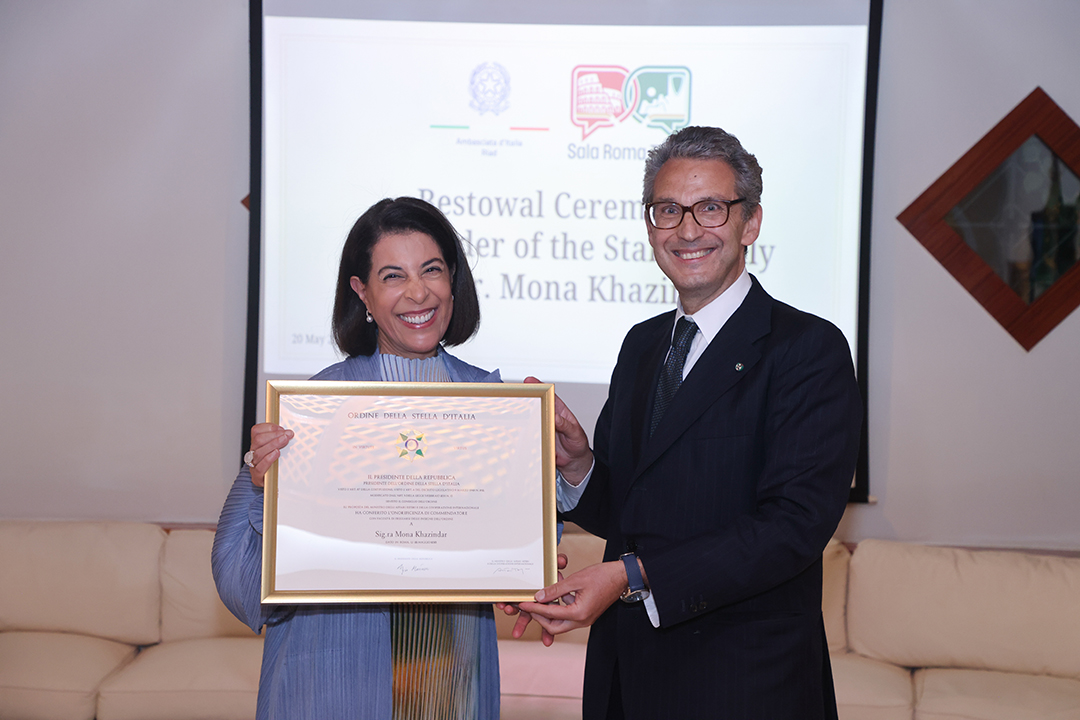
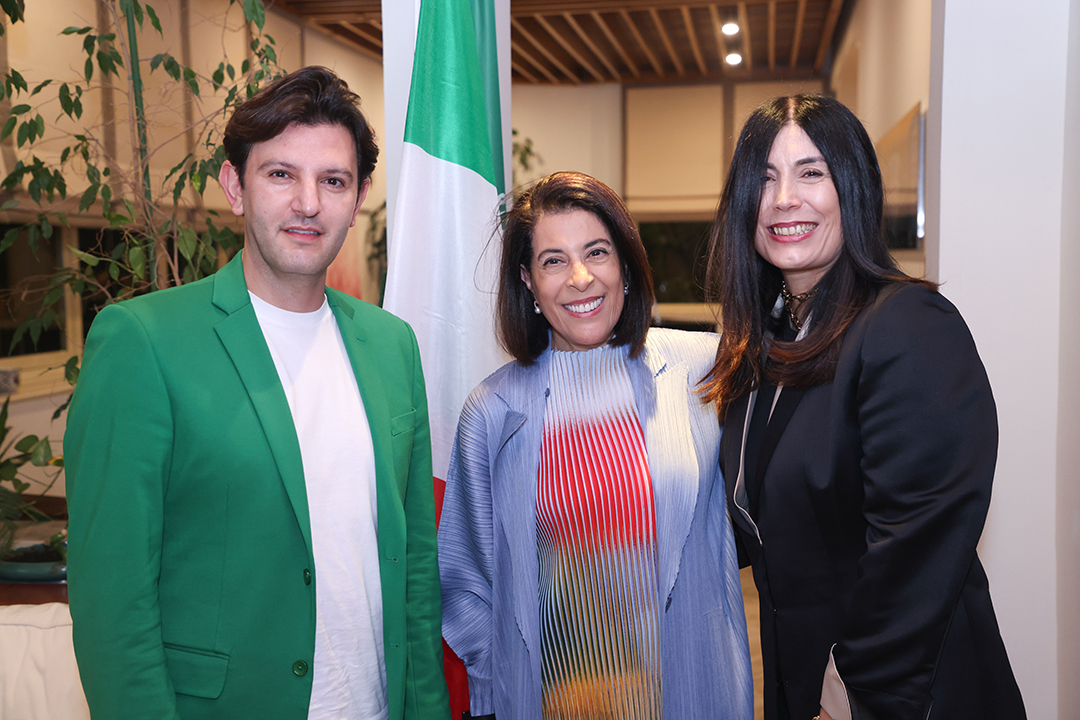
The Italian Embassy in Saudi Arabia recently hosted an inspiring edition of its “Sala Roma Talks” series, an exceptional platform for the exchange of Italian and Saudi perspectives on cultural and artistic diplomacy. Among the distinguished voices featured in the series was Dr. Mona Khazindar, who was awarded the Ordine della Stella d’Italia (Order of the Star of Italy).
Curator and historian Dr. Mona Khazindar has curated numerous international exhibitions over the past three decades. She became the first woman—and the first Saudi—to serve as director of the Institut du Monde Arabe in Paris (Arab World Institute of Paris). Dr. Khazindar has made a significant contribution to the development of Saudi-Italian cultural diplomacy through projects including biennials, exhibitions, books, and her participation in the creation of one of the Kingdom’s most distinctive design museums. As part of the Sala Roma Talks project, following the awards ceremony, Dr. Mona shared her thoughts on art, culture, the role of museums, and society’s vision of art.
What is your unique definition of a museum, and how would you evaluate the museum culture in Saudi Arabia?
A museum is the past, present and future; a space that unites the community. Museums bring people together around the world through its exhibitions, displays, and narratives.
Speaking about the museum culture of Saudi Arabia, I am pleased to note that there are many museums in the Kingdom that tell the story of the country’s history through different periods, which indicates a growing demand for museum culture as an educational center for local residents and tourists. Saudi museums are thematic and focused, such as Red Sea Museum and Jeddah Museum. We have separate museums dedicated to each region of Saudi Arabia.
In keeping with this traditional approach to museology, we are also working on a completely new project. We are currently collaborating with Italy to launch a design museum in Riyadh. The design museum is intended to have a special significance, demonstrating that a museum is not just a building that houses artifacts, but also an institution where curators, developers, and educators meet to educate our visitors. Two years ago, guided by this vision, we signed a memorandum of understanding with our Italian colleagues to create a design museum that will become a living, dynamic space in its own right.
You mentioned a number of museums in Saudi Arabia, each dedicated to a different theme. Which of these museums would you consider truly unique?
As an example, I would like to recall the Black Gold Museum, also known as the Oil Museum. The topic seems obvious, but in reality, it is so complex that it [apparently]cannot be presented within the framework of an art museum practice. Oil museums typically focus on science, but we took a different artistic approach that allowed us to show the oil to the audience through the eyes of the artists.
Located within the King Abdullah Petroleum Studies and Research Center (KAPSARC), this museum is based on four themes. We began with the Encounter with oil, and its discovery—the beginning of a “love story.” Then we moved on to Dreams—cars, airplanes, fashion, design—oil is everywhere, and it makes our lives better. As with any love story, at the third stage in the museum, Doubts arise: would this relationship work out or not? And the final theme is dedicated to the Future. What will humanity’s future look like with energy?
The Black Gold Museum is a truly unique place, showcasing the role of oil in global society and its enormous contribution to our prosperity, leading to new scientific discoveries in the energy sector and beyond.
In recent years, the term “vision” has become a truly driving force, especially in the Kingdom. Please share your thoughts on art and culture in bringing Vision 2030 to life, and Italy’s role in this process.
Our leadership is very conscious about the importance of arts and culture both within and beyond Vision 2030, as culture and arts play a crucial role in the country’s development in various areas, especially as our economy strives to reduce its dependence on oil. Therefore, Saudi government invests in arts and culture while collaborating with the right partners, such as Italy; a country of heritage, culture, art, fashion, etc. Saudi Arabia is collaborating with Italy to develop all aspects of culture, not just museums but also, for example, archaeology. Here I would like to highlight the archaeological projects in particular; we share the common history of the Nabataeans and the Roman Empire, which developed from a strategic alliance into a vital trading partnership.
Another promising area of collaboration I would like to highlight is architecture. Italy is rightly renowned for its historical influence on architecture, not only domestically but internationally. In Saudi Arabia, I would like to cite the example of Diriyah Art Futures, an internationally award-winning arts center in Diriyah. This stunning building was designed by the renowned Italian architecture firm Schiattarella Associati. Indeed, Diriyah Art Futures is a unique project in which Schiattarella Associati has succeeded, creating an organic urban complex that blends seamlessly into the natural Wadi bed, reviving traditional forms reminiscent of old Diriyah; it is a tribute to vernacular architecture through a contemporary lens.
Last but not least, Italy has a long and fascinating tradition of restoring cultural heritage sites and works of art. This experience is crucial for Saudi Arabia, where historical sites are actively studied and restored for present and future generations, as well as for the growing number of tourists visiting the Kingdom. I believe that these arguments and examples are best suited to achieving the success of the Vision 2030 goals in the field of arts and culture with the continued support of Italian experience.
As you rightly noted, Italian experience and artistic vision existed in the Kingdom both in ancient times and in the 21st century. What are your observations regarding the period between ancient times and the 21st century?
It is gratifying to note that even after the historical Nabatean Kingdom and the Roman Empire, the connection between Italy and Saudi Arabia remained strong, thanks to arts and culture. In 1503, the first European to set foot on Arabian soil was Ludovico di Varthema of Bologna. He was an Italian traveler, known for being one of the first non-Muslim Europeans to enter Mecca and Medina with a caravan. Essentially, he presented [then]Arabia in a highly objective, respectful, and balanced manner. In the 20th century, another historical figure who revealed Saudi Arabia to the world from a different perspective was “Ilo the Pirate.” He was an Italian draftsman and photographer who captured Saudi Arabia in 1940s-50s, providing a rare and intimate glimpse into the Kingdom during a period of major modernization and cultural transformation. I would also like to mention Luigi Pellegrin, a visionary Italian architect who designed 72 schools in Saudi Arabia in the 20th century. The school projects and design emphasized industrialization and the mobility of building elements to create durable and educationally innovative spaces.
These and many other individuals played a decisive role in introducing Saudi Arabia to the world long before the advent of modern technology and media. This tradition continues in the 21st century through our deepening collaboration with leading Italian companies and experts, taking cultural diplomacy to a new level of mutual understanding and recognition.